
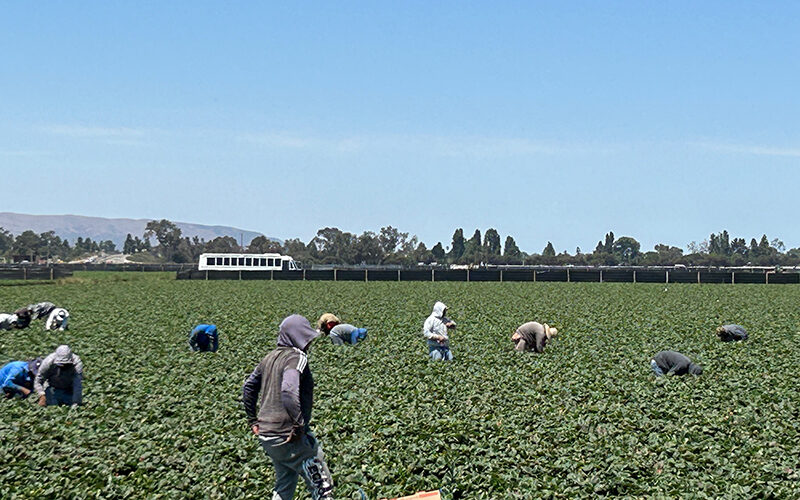
Strawberry pickers in the Santa Maria Valley work bent over for hours in the hot sun. Photo: Robert J. Lopez
In 2023, investigative reporter Robert J. Lopez met with about a dozen child farmworkers on California’s Central Coast. He wanted to know about their experiences working on farms and what he heard was deeply distressing: They told him about toiling in fields that smelled of chemicals, about skin peeling off their fingers from exposure to pesticides, about working for less than minimum wage and about laboring in extreme heat without shade or sufficient water breaks.
The interviews set Lopez on a path to investigate how these conditions could exist in California – a state with some of the strictest child labor laws in the country. His reporting led him to seek the release of thousands of public records from state and local oversight agencies, including inspections, investigations, fines and citations. He faced prolonged delays and officials who ignored his requests but kept pushing until he ultimately got the records released.
The resulting stories, published in Capital & Main and the Los Angeles Times in partnership with the McGraw Center for Business Journalism, showed a pattern of lax oversight that left children exposed to dangerous and arduous conditions while working in the fields.
This is one in a long list of deeply-reported investigative stories that Lopez has undertaken during his career. He fought for years to get access to public records about a sheriff’s deputy’s killing of Los Angeles Times columnist Ruben Salazar in 1970, helped expose government corruption in the small Los Angeles County city of Bell and uncovered corruption and worker exploitation in California’s legal cannabis market.
Recently, FAC talked with Lopez about why he set about reporting on child farmworkers in California, how he overcame challenges to obtain vital public records and developed trust with young workers and their families. He also offered advice to reporters who want to pursue public records-based work but run into delays and denials.
Q: Your story delves deeply into a subject that is extremely difficult to report on: children who often work in the shadows on California’s agricultural fields. How did you come to this story?
A: I was interested in issues involving farmworkers like substandard housing, lack of housing, affordable housing and other kinds of hardships like that. Then in summer 2023, during some preliminary interviews, labor advocates started talking about child farm workers toiling in the fields. So I started looking into that nationally at first and then ultimately sort of honed it down to California.
I was interested in looking at systemic issues involving underage workers in California. It couldn’t just be a story about sad tales. It had to be investigative. So I was interested in who regulates all this and how good of a job are they doing? California has the largest agricultural industry in the nation, one of the largest in the world. And California also has some of the toughest child labor laws in the country.
In early fall of 2023, I lined up interviews with about eight underage workers in the Santa Maria area, which is one of the top agricultural producing regions in California, and I went over there to visit them. And I immediately began hearing about how they worked in fields that smelled of chemicals and how they had watery eyes. One young girl said the skin peeled off her fingers and they turned white. Then I interviewed six others the following evening and some of them had similar stories, in addition to not necessarily earning minimum wage and working in the sun in extreme heat without shade, without extra water breaks. And so it became really clear after those early conversations that, you know, this was a story worthy of pursuit.
Q: How did you go about identifying the specific records that you needed to request to help tell this story?
A: There were specifically four agencies [involved in regulating child farmworkers.] There is the Division of Occupational Safety and Health, known as Cal/OSHA, and they are responsible for regulating workplace safety.
For child labor specifically, that was the Division of Labor Standards Enforcement, and it has something called the Bureau of Field Enforcement. They’re responsible for enforcing all child labor laws here in the state. Then on the pesticides, there was the state Department of Pesticide Regulation, which has overall responsibility for enforcing pesticide law in California.
And then, at the county level, I learned that there were these officials called agricultural commissioners who were responsible for enforcing pesticide laws at the county level. And they also are responsible for promoting agriculture. I thought that was rather interesting.
So those were the four distinct parts that I had to look at.
I had a source who used to work at Cal/OSHA. I met this person and we talked about how records were kept. I needed to understand their records system, what types of records do you have, what kinds of inspections do you do? How is this cataloged on your databases? Sort of just understanding the record system. This source explained that to me and then this source connected me to another source, in the Division of Labor Standards Enforcement, who was able to explain record management systems there.
I filed my initial round of public records act requests just for data, not actual specific reports, because I wanted to see how big the universe was. So I asked for enforcement records, by sector. I wanted like 10 years worth of data.
On the pesticide side, I really didn’t know much. So I just researched to see what had been written. And there had been a lot written about just the dangers of pesticides, not only for farmworkers, but for women who were pregnant. The dangers for communities that were next to fields. There’d been a lot of studies on that and a lot of journalism had been written about that. But what had not been written was how well were the agricultural commissioners in the state doing when it came to enforcement, and how do they really do enforcement? So I needed to learn that.
I started off by just calling several. I actually stopped in their offices when I was in the fields, in Monterey and other counties, and left my cards. And I started talking to some agricultural commissioners. I just wanted to know how they do their jobs. What is it that you do? How do you regulate pesticides? What kind of inspections do you do? Just sort of the mechanics of their jobs and what they did.
Q: You asked the state Department of Industrial Relations for detailed enforcement records, but they failed to respond to those requests for 11 months and only provided all the data after the Press Freedom Project at UC Irvine’s law school wrote a letter threatening a lawsuit. Can you talk about that 11 month period?
A: They said the information that I was seeking, most of it was privileged. Those are their exact words. There’s no such thing as privilege, in terms of exemptions, under the California Public Records Act.
So I wrote them and said: you need to cite a specific exemption, if you’re going to withhold stuff. Ultimately, we got them to give up a little more information, but still, not everything that I wanted. I kept pressing them for more records. And they just stopped responding to me. I mean, it just got to a point where they just wouldn’t even respond anymore.
Ultimately I connected with attorney Susan Seager at the Press Freedom Project and she and her students represented me pro bono. They wrote a very strong letter to the Department of Industrial Relations basically telling them that she represented me and she listed all the violations of state law. She basically told them that if they didn’t begin producing records immediately she would file a lawsuit in Alameda County Superior Court, where the Department of Industrial Relations is headquartered in Oakland.
And within 48 hours, they buckled and agreed to begin producing records, and even then it still took about five weeks, but I got everything that I wanted. And, you know, it revealed some pretty interesting statewide breakdowns across the board.
Q: Is there anything specific that stands out from that release?
A: Yeah. Over an eight-year period there were 27 citations issued [by the Bureau of Field Enforcement] for agricultural violations, even though thousands of agricultural businesses operate in California. More than 90 percent of the money, the fines, had never been collected. A majority of the complaints, thousands of complaints filed against employers … alleging violations of the outdoor heat safety law were not investigated. Thousands of complaints or injury and accident reports for agricultural businesses were not investigated. More than 600 investigations for agricultural violations of all types were letter investigations, meaning nobody ever went to the work site to ascertain what had happened, or get facts. Cal/OSHA issued $32 million in fines over a 10-year period. They collected less than half of that. So it was those types of findings. In addition, you know, inspections of all types dropped. The number of citations issued to employers over a 10-year period dropped by 74 percent. Those are probably the major findings that I got from all those records after I analyzed them.
Q: In addition to all the record-based reporting, you interviewed more than 60 young farmworkers who talked about what it was like to do their work, sometimes for less than minimum wage, sometimes without water breaks or clean toilets. Was it difficult to get young people to open up to you about this work and the challenges that they face?
A: The thing that I did, in terms of my approach, is that I explained to people that I’m a veteran journalist and this is a really important topic and I want to handle it with the sensitivity and respect that it deserves. I’m not here to exploit or use these young people for my personal gain. I believe it’s really important that readers understand the labor and sometimes danger that goes into providing these fresh vegetables and fruit on their tables.
I also told them that I wanted to take a hard look at the agencies that were responsible for protecting these young people and workers in general, because no one had really ever done that. And you know, they really wanted to tell their stories in the end because they wanted people to know about the pain and suffering that goes into picking fruits, planting vegetables, harvesting.
They also wanted to let people know so that maybe things could change. None of these kids want to be working out there and their parents don’t really want them to be working out there. The bottom line in all of this is it’s an issue of poverty. And you’re talking about families that are barely making it, barely surviving. These young people are out in the fields because they have to be, to help their families pay bills, put food on the table.
More importantly, they knew that I wouldn’t do anything that would get them in trouble or would get their parents in trouble or might even get them deported, because a lot of the young people I spoke to were born here, but they’re from mixed immigration status families. The parents may not have documentation.
I worked on this project for 25 months. And in the end, I drove nearly 15,500 miles across California. But I was able to immerse myself in these communities. I was able to just sort of listen at times and not even ask questions. I went to community meetings, a community dinner, a community breakfast. I went to food banks where farm workers were lined up for blocks for food, mothers and children. I really tried to develop a sort of complete understanding of their lives as opposed to just sort of parachuting in and getting a quick interview. I didn’t really want to do that. And it was through those repeated visits that I was able to gain the trust of these kids and their families.
Q: After your stories were published, California announced that it was making some changes to try to better protect young farmworkers. Can you talk about some of those changes that have been promised?
A: After my stories were published I went to the governor’s office and I asked them a series of questions. In essence, the questions were: Are you satisfied with these findings? And if not, what are some of the things that you are going to do to address these issues?
So the state said it was going to begin conducting joint operations between Cal/OSHA and the Bureau of Field Enforcement. They typically enforce different laws and their inspectors do field work separately. But by joining forces, they said they would be able to increase their presence and identify more violators. They also announced data sharing among enforcement teams from the Agricultural Labor Relations Board, Department of Industrial Relations and other agencies that deal with farm workers and farm worker rights, to share data and also identify potential cases for investigation and increase their presence in the fields.
So basically you’re talking about increased enforcement and data sharing to really increase the presence of investigators out there, cite more violators and have a deterrent effect by being out there.
Q: You’ve built a career doing powerful investigative work that’s often based on public records. What would you say to young journalists about why they should pursue this type of reporting, given how challenging it can be, and how often they will probably be confronted with prolonged delays and unjustified denials? Do you have any advice for them?
A: Well, the first thing I would say is that the California Public Records Act is one of your best weapons in terms of getting information. You need to know what your rights are under the law. You should definitely be familiar with that. When you make a request, try to be as specific as possible. And you just have to be persistent.
If they don’t respond to you, you just need to respond to them and remind them that they’re required to respond within 10 days. And document everything. Number two, if they withhold data, you need to ask them to be specific about why they’re not providing it. They have to do that under the law.
And you just have to really be ready to be in it for the long haul because it’s just not necessarily an easy process. It can take a long time as it did with me. It’s really easy to move on to the next thing. But If we fail to hold these agencies accountable and fail to keep pressing them, then they get away with it, and then they win. And then that only just makes them more empowered the next time someone comes along and asks for records.
This interview has been edited and condensed for clarity.
Read Lopez’ coverage here: